


Orthodontic braces – fabrication and wear instructions
For all types of orthodontic appliances it is necessary to perform the following at the dental clinic:
– panoramic X-ray image of all teeth
– dental impressions for study models at the beginning of orthodontic treatment.
FIXED ORTHODONTIC APPLIANCE
Placement:
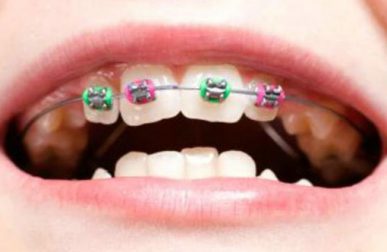
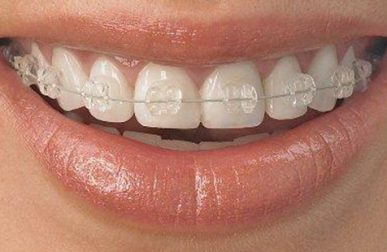
Orthodontic brackets are imported and bonded to all teeth using composite material. A thin, barely visible wire arch is inserted into the bracket slots and connected with transparent, barely visible elastic ligatures. If necessary, brackets can be removed during treatment with a special instrument and placed again. Neither the brackets nor the composite bonding material damage the tooth enamel.
Instructions for wearing:
A fixed appliance must be activated during regular check-ups every 4-6 weeks. Without regular reactivation of the appliance, the treatment is not successful and the teeth do not move. Regular attendance at check-ups has a major influence on the duration of the entire orthodontic treatment. After placement of the appliance, as well as after check-ups, there is a possibility of slight tooth sensitivity that does not last longer than two to three days. The oral mucosa and lips need some time to adapt to the brackets. Soft wax is used to help with adaptation, which the patient applies themselves and receives when the appliance is placed. Transparent elastic ligatures used to connect the wire arch and brackets are changed at every check-up. They can change color between two appointments due to pigments from food and drinks. There are also self-ligating brackets where elastic ligatures are not required and which are used in some cases. It is possible that an individual bracket may come loose during treatment. In that case, it is necessary to call the clinic and arrange an appointment so that it can be reattached to the tooth. To prevent brackets from coming loose and breaking, it is necessary to pay attention to diet and certain habits. Patients who have fixed orthodontic appliances should not bite food directly but should cut it into smaller pieces with a knife and fork. They should also avoid sticky food and caramels because anything that can detach the bracket from the tooth represents a risk.
When wearing a fixed orthodontic appliance, the patient can eat everything but should avoid, for example, biting into a sandwich or an apple. Instead, pieces should be torn by hand or cut with a knife and such smaller pieces should be placed into the mouth. Hygiene during wearing an appliance must be excellent so that food remains and bacteria do not accumulate and plaque does not form, which can cause gum inflammation and tooth decay. It is recommended to clean dental calculus every 6 months, and more often if necessary. The gingiva while wearing an appliance can slightly swell in some patients and partially cover the tooth crown, but after removing the appliance it will recede and return to normal within two weeks.
Removal of the fixed appliance:
Treatment lasts a minimum of one year because this is the minimum time required for teeth to move and, after movement, become stabilized in the bone and achieve stable results. On average, treatment in our clinic lasts 1-1.5 years. After moving the teeth, the same amount of time is needed for them to stabilize in the bone, which is why patients after fixed orthodontic treatment must wear retention appliances. The duration of the retention period is individual for each patient and depends on the anomaly they had, age and periodontal condition. Retention appliances can be: 1. fixed (the teeth are connected from the back side with a wire and composite resin) and 2. removable (transparent retainer).
After removing the fixed appliance, the retainer should be worn continuously during the first month except during eating and drinking, and the wearing time is then gradually reduced. Patients in the retention phase must come for check-ups at least 3 to 4 times a year.
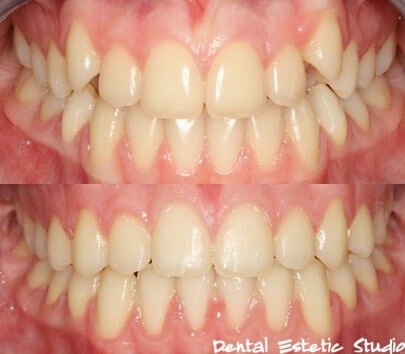
Before and after fixed orthodontic treatment
REMOVABLE ORTHODONTIC APPLIANCE
Fabrication:
Based on the dental impression of the patient, the orthodontic dental laboratory creates a removable appliance that can be made in various colors. It consists of an acrylic plate and wire and is very easy to place on the teeth.
Wearing:
The removable appliance is worn on average around 14 hours a day, mainly during the night and during the day whenever it is possible for the patient. The duration of treatment is highly individual and depends on each case. A removable orthodontic appliance requires good patient cooperation. Since it is most often used for children, a positive attitude and support from parents are extremely important. Check-ups every 6 to 8 weeks are mandatory for a removable appliance.
Treatment possibilities:
A removable orthodontic appliance has limited possibilities for tooth movement compared to a fixed appliance. It is used in younger children when it is necessary to influence the development of dental arches, modify growth or help stop harmful habits such as tongue thrusting or thumb sucking. Such therapy in younger children prevents the development of more serious anomalies but is not a guarantee that the child will not need a fixed appliance later after the eruption of all permanent teeth. Removable therapy at a younger age can help successfully resolve some anomalies and can help make fixed therapy shorter and achieve a better result. A removable appliance can also be worn by adults, but only for minor tooth movements.
ORTHOCAPS INVISIBLE ORTHODONTICS
Fabrication:
Whether and how a patient’s case can be treated with Orthocaps therapy is decided by the Orthocaps base in Germany, where aligners are produced for all clinics worldwide licensed to work with Orthocaps. The clinic takes professional photographs based on which it communicates with them about treatment possibilities and sends special impressions used to create aligners that move the teeth. Each patient receives a large box with aligners. During production in Germany, a computer system creates aligners individually for each patient. The patient receives a box with their aligners (CAPS), which they replace with new ones every 3 weeks, and each new aligner moves the teeth again by a fraction of a millimeter. Orthocaps uses soft aligners (SOFT CAPS) and hard aligners (HARD CAPS) during treatment because it has been scientifically proven that this method of tooth movement is the healthiest for the periodontium and the most effective. Orthocaps often requires placing almost invisible small composite stoppers on some teeth before treatment and tooth stripping. Stoppers enable different types of tooth movement.
Stripping – is a micro-reduction of tooth width using special strips, which is performed worldwide in orthodontics when there is insufficient space, and with Orthocaps the doctor performs it during individual check-ups precisely according to the instructions of the Orthocaps base.
Nošenje:
The patient must strictly follow the instructions for wearing the appliance. The patient wears aligners 24 hours a day (minimum 22 hours) and removes them when eating or drinking anything except water. The advantage of this type of treatment is that the appliance can be removed, hygiene is easier, and it can be removed on special occasions. The patient always starts a new three-month cycle of new aligners by wearing only soft SOFT CAPS during the first week, and after that HARD CAPS during the day and SOFT CAPS at night for the next two weeks. Treatment: It lasts around 1 year, maximum 1.5 years, depending on the case. The Orthocaps base decides whether the treatment will proceed in 1 phase or, in more complex cases, in 2-3 phases. This means that if the Orthocaps base determines that the treatment will proceed in multiple phases, after the first phase a new impression must be taken, which is sent again to Germany, from where a new box with continuation of treatment will arrive. In that case, the patient only pays additional DHL shipping and return shipment costs. When tooth movement treatment is completed, the patient continues wearing the final aligner at night for another year.
BLOG POSTS YOU MIGHT BE INTERESTED IN








REQUEST ADDITIONAL INFORMATION, CONSULT WITH US OR REQUEST AN OFFER
AND
WE WILL GET BACK TO YOU AS SOON AS POSSIBLE
Call us at +385 1 4847 432 or send us a message via the inquiry form.
DEŽMANOVA 5, ZAGREB, CROATIA
info@ordinacijaknego.hr